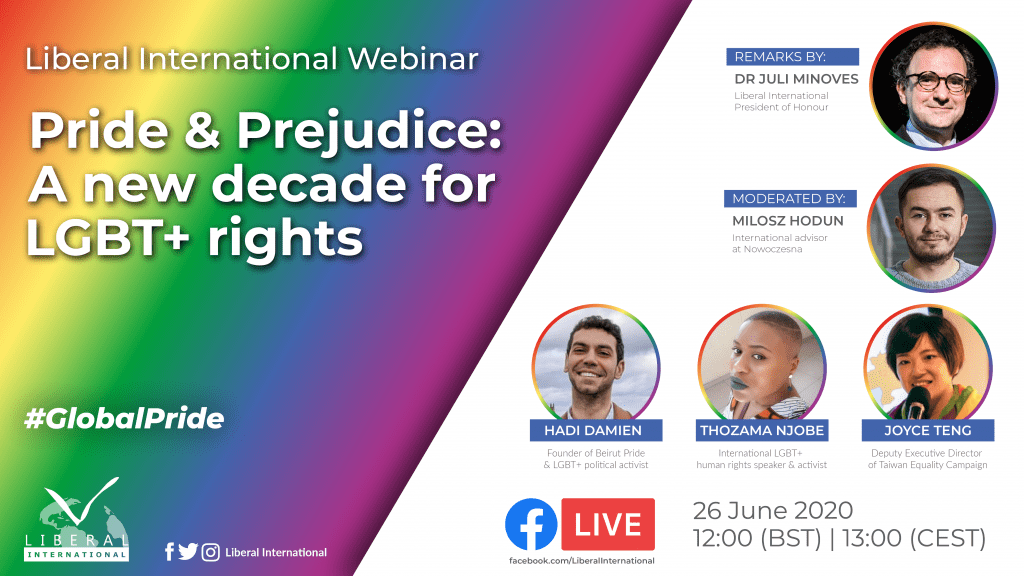
On Friday, 26 June 2020, Liberal International (LI) was proud to bring together a multi-regional panel of LGBT+ activists, politicians, human rights defenders and allies entitled “Pride & Prejudice: A new decade for LGBT+ rights.”
With the inauguration of Global Pride on Saturday the 27th and commemorating the 51st anniversary of the Stonewall riots on the 28th, LI recognises the huge strides and immense sacrifices that have been made over these past 5 decades. Just over the last two, legislation decriminalising homosexuality and legalising same-sex marriage has paved the way for a more equal society. Despite these advances regrettably there are still 70 countries that criminalise LGBT+ people, 12 territories still carry the death penalty.
This geographically diverse panel brought together the likes of LI President of Honour and former Ambassador to the United Nations: Dr Juli Minoves (Andorra); the founder of Beirut Pride: Hadi Damien (Lebanon); international LGBT+ human rights activist: Thozama Njobe (South Africa); Deputy Executive Director of Taiwan Equality Campaign: Joyce Teng (Taiwan); and was moderated by international advisor for Nowoczesna and European Liberal Forum board member: Dr Miłosz Hodun (Poland).
Main Outcomes
Global Pride
Global Pride was established as more than 500 pride organisers came together to mobilise a 24-hour broadcast. This year, global pride highlighted segments from past pride events, public speakers, politicians, and celebrities, as well as having particular focus on involving members living in challenging environments; where LGBT+ people are criminalised, in countries that do not have pride organisations but have been witnessing a lot of effort around LGBT+ visibility to bring their voices to the fore.
This year in particular, was of utmost significance as the lack of visibility for Pride Marches have had huge consequences as they have had to be cancelled or postponed globally due to the COVID19 pandemic.
Regional Contexts
Dr. Miłosz Hodun, of Poland, noted that the Rainbow Europe Index has ranked his country as the most homophobic country in the EU, suffering from populist politicians campaigning on a specifically anti-LGBT+ platform. On Sunday, 28 June 2020, Polish citizens went to the polls to vote for a new President, where the politics of discrimination were successfully countered by liberal political leaders in the country. A run-off election is set for July 12th, leaving a space for members of the Polish LGBT+ community to hope for positive change brought about by a liberal President.
Regarding the Middle Eastern context, Hadi Damien, of Lebanon, provided a brief overview of the high prevalence of criminalisation of the LGBT community as well as a cultural context that remains traditional. However, the wave of political unrest that has swept the region in recent years is cause for optimism; generally, along with demands of governance reform, citizens have pushed for liberalisation and protection of civil and human rights, including LGBT+ rights.
Thozama Njobe, of South Africa, commended the strides that have been made in Africa in recent years; from the landmark ruling in Botswana to decriminalise homosexuality to the strides made in Angola, Mozambique and Seychelles. In contrast, however, she cautioned that there is still much progress to be made; from a continental perspective, Njobe highlighted that issues around funding in the global south are negatively impacting progress in the region. Niche issues that are relevant in the home context of funding partners get a disproportionately large amount of funding compared to more basic, but less politically relevant, issues. Populist leaders throughout the African continent, continue to use LGBT+ rights as a political tool, endangering the positive developments that have been achieved.
Joyce Teng, of the Marriage Equality Coalition of Taiwan, expressed hope at seeing the continued trend of liberalisation across the Asian continent regarding LGBT+ rights. Taiwan, for example, is one the leading Asian nations on the recognition of the rights of their LGBT+ community. In 2019, LI Member and ruling party of Taiwan, the Democratic Progressive Party, passed a law legalising same-sex marriage. Although the law does not grant total equality, Teng believes this progress is emblematic of a region in transition.
The Next Decade: Priorities & Recommendations
Liberal International has noticed the erosion of democratic values, this regression of democracy and regression of human rights doesn’t help the Social Justice movement of LGBT+ rights. We must collaborate as liberals and defend our democratic rights.
On Decriminalisation:
From a liberal perspective, decriminalising LGBT+ citizens is basic standard that must be met within democratic societies.
Criminalising LGBT+ citizens is an abuse of their basic human and civil rights, and should be resisted by all those who believe in the principle of the indivisibility and universality of rights.
Decriminalisation does not ‘instantly’ make LGBT+ lives better, but it does offer direct/indirect legal grounds for fundamental protection of the community; it insulates LGBT+ individuals from hostile populist winds and creates the foundation for building up progressive change within societies.
On Education:
In order to change discriminatory societal attitudes toward LGBT+ communities in every region of the world, it is essential to invest in education that promotes the values of tolerance and openness to the other. In societies where individuals are taught about different healthy family structures and about LGBT+ people, there is a measurable trend toward acceptance of the LGBT+ community.
Education is also a way to fight against the false idea found on every continent that being LGBT+ is “un-African”, “un-Asian”, etc.
On Funding:
Sufficient and appropriately targeted funding must be made available to civil society movements fighting for the recognition of LGBT+ human and civil rights.
Growing the capacity of LGBT+ movements to advocate for their rights is also a way to grow their visibility within society and initiate progressively minded dialogues.
Engaging the political class and private industry in fundraising is essential in order to raise the investment necessary to influence entire societies.