Europe’s security challenges can no longer be viewed in isolation. From Russia’s continued aggression against Ukraine to emerging technologies, the Black Sea and the rapidly evolving Arctic, the continent faces an increasingly interconnected security landscape that demands coordinated liberal responses.
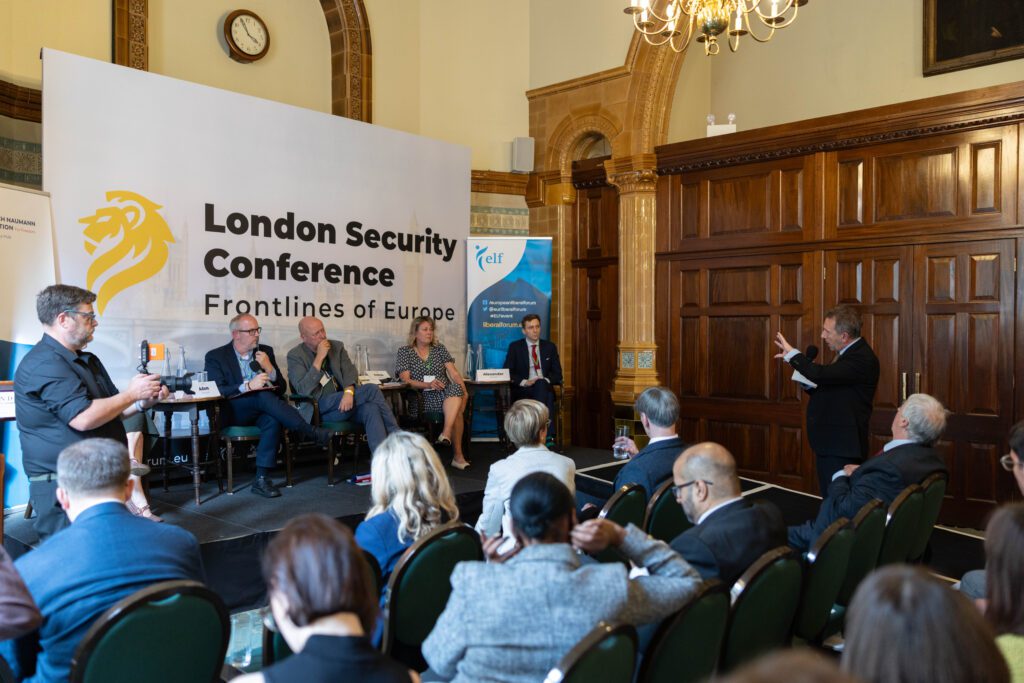
Against this backdrop, Liberal International convened the inaugural London Security Conference at the National Liberal Club on 7 September, bringing together parliamentarians, policymakers, diplomats, academics and civil society leaders from across Europe and beyond to examine the future of European security.
Delivering the keynote address, Sir Ed Davey MP, Leader of the UK Liberal Democrats, framed the challenge facing liberal democracies in stark terms:
“These are challenges that no nation can afford to ignore. And challenges that no nation can tackle alone.”
Throughout the day, discussions focused on four defining themes: the impact of emerging technologies on European defence, the need for a coherent long-term strategy in the Black Sea, strengthening democratic resilience in Eastern Europe, and the future of governance in an increasingly contested Arctic.
One of the conference’s recurring messages was that security is not measured solely by military capabilities. It also depends on resilient societies, strong institutions and international cooperation.
This was particularly evident during the panel on Arctic security. Lori Idlout MP, representing Nunavut in the Canadian Parliament, reminded delegates that security begins with the people who call the Arctic home, arguing that investing in northern communities is essential to safeguarding the region’s future. Former Greenlandic Foreign Minister Vivian Motzfeldt reinforced the importance of values-based leadership, stating:
“In Greenland, we stand by our values, rooted in international law, territorial integrity, and the right to self-determination.”
Together, these discussions underscored the Arctic’s emergence as a strategic priority – not only because of geopolitical competition, but because of its growing significance for international law, regional stability and transatlantic cooperation.
Across every session, speakers returned to a common conclusion: Europe’s security and its democratic future are inseparable. Building resilience requires sustained partnerships, investment in innovation, and a renewed commitment to the liberal values that underpin peace and international cooperation.
Liberal International extends its sincere thanks to all speakers, moderators, partners and delegates whose contributions made the inaugural London Security Conference a resounding success. The conversations launched in London will continue to inform our work as we strengthen liberal cooperation to meet the security challenges of the years ahead.