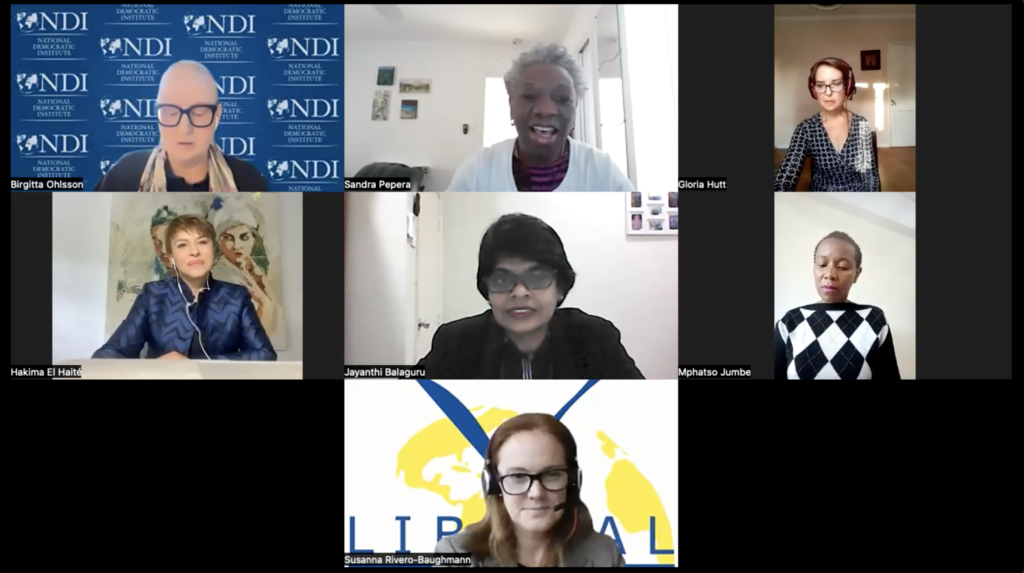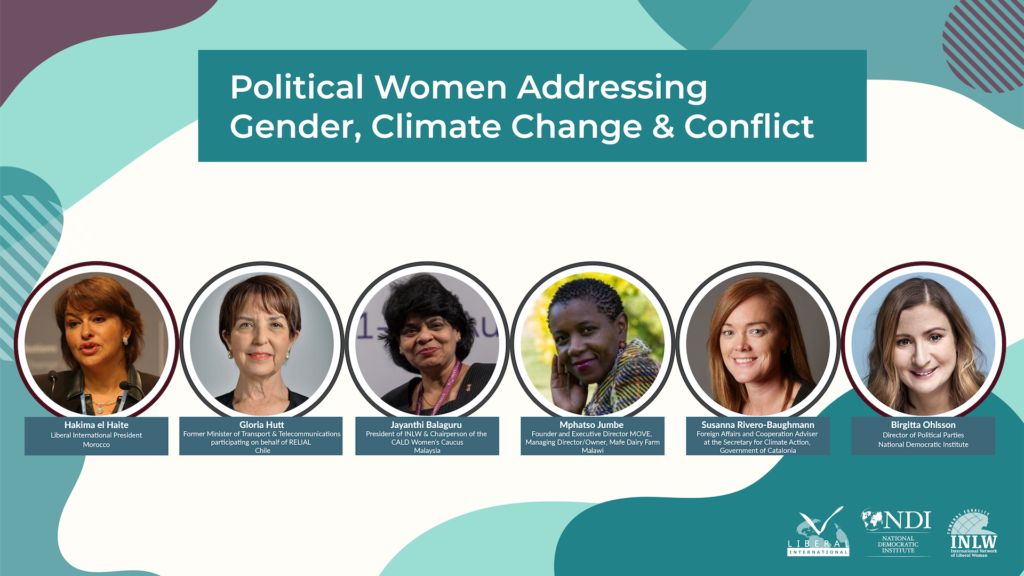
On March 14, Liberal International (LI), National Democratic Institute (NDI), and International Network of Liberal Women (INLW) kicked off the UN Commission on the Status of Women with “Political Women Addressing Gender, Climate Change and Conflict.”
The panel discussion, moderated by NDI Director of Political Parties, Birgitta Ohlsson, featured a high-profile cast of policy experts from four continents.
LI President Dr. Hakima el Haité opened the panel and emphasized that climate change is a matter of social justice:
“We need to understand that climate change, sustainable development, and all the rights of women are the faces of the same coin; we cannot reach sustainable development, we cannot fight and eradicate poverty if we do not deal with climate change.”
Gloria Hutt, Former Minister of Transportation and Telecommunications of Chile and participated on behalf of Red Liberal de América Latina (RELIAL), shared the importance of integrating women’s issues in all sectors of political agendas and increasing women’s visibility. For example, in Chile’s transportation sector, a scoring system incentivizes the hiring of more women into a department that is central to climate change.
Hutt also spoke of the implications of gender equality for liberals.
“Being liberal means having the freedom to choose, and to be free to choose, you must have equal opportunities”
From Malaysia, Jayanthi Balaguru, President of INLW and Chairperson of Council of the Asian Liberals and Democrats Women’s Caucus shared that a lack of gender mainstreaming in parliament presented serious barriers to meaningful action, highlighting its importance.
Balaguru shared insights on how labour policies can be used to protect women and the climate on a national and regional level.
In Malawi, land justice is critical to gender, climate, and conflict justice, and women’s indigenous knowledge should be mainstreamed, explained Mphatso Jumbe, Founder and Executive Director of MOVE and Managing Director/Owner of Mafe Dairy Farm.
Women possess intimate knowledge of the uses of land and resource distribution that is critical to mitigating the impacts of conflict and climate change and on par with the valuable solutions promoted by scientists. However, this knowledge is not mainstreamed to higher levels of policymaking because it is not peer-reviewed; it does not conform to traditional understandings of policy solutions.
In order to mainstream their indigenous knowledge at the policymaking level, politicians must appreciate greater diversity in democracy and human rights work, Jumbe explained.
Susanna Rivero-Baughmann, Foreign Affairs and Cooperation Adviser at the Secretary for Climate Action, Catalonia and Deputy Chair of the LI Climate Justice Committee (CJC), shared her experience of catalyzing action through demonstrating the benefits of environmental management on the ground and connecting national and sub-national efforts.
As Deputy Chair of LI’s CJC, Rivero-Baughmann also shared some of the Committee’s woman-led work driving a rights-based approach to climate change. The CJC’s flagship initiatives included a climate displacement initiative calling for an international framework to support climate-induced migrants and a working paper on the link between climate justice and human rights.
Ohlsson concluded the webinar with a reminder of the importance of liberal democracies in promoting progressive outcomes, inspired by the words of climate activist Greta Thunberg: “Fighting for climate justice is also fighting for democracy […] Democracy is everything, and we can’t save the living planet without it.”
Panellists: