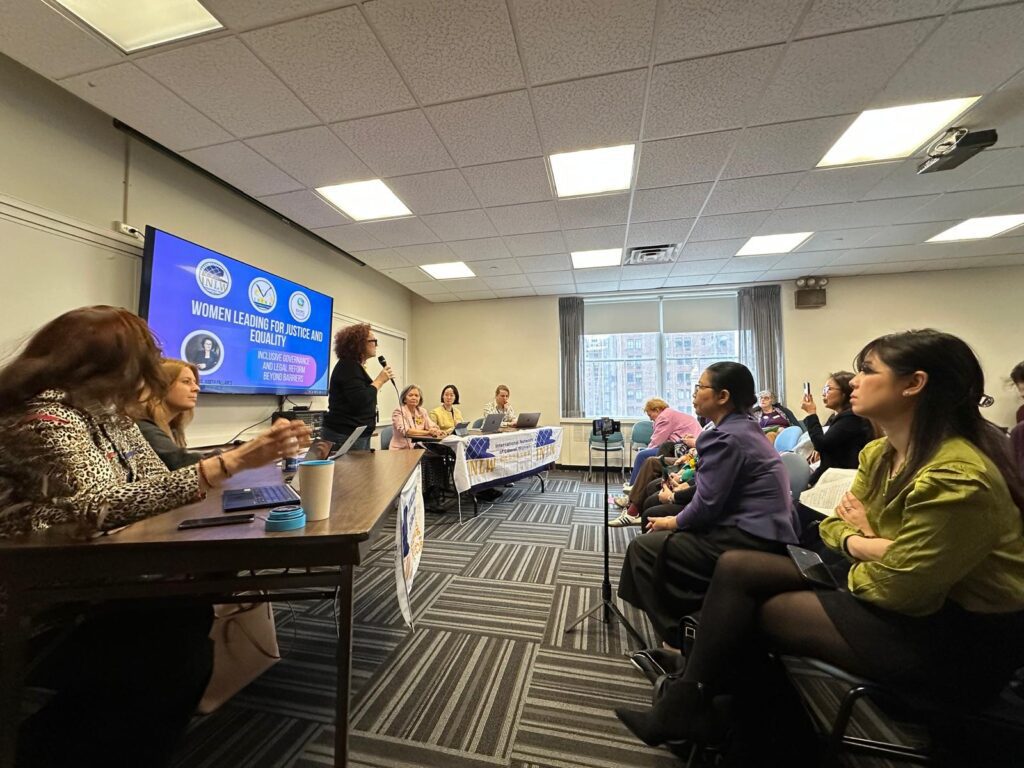
On 12 March 2026, in the framework of United Nations Commission on the Status of Women (UNCSW), Liberal International (LI) and International Network of Liberal Women (INWL) held a joint side event “Women Leading for Justice and Equality: Inclusive Governance and Legal Reform Beyond Barriers”. The event explored the importance of women’s leadership in justice, promoting inclusive governance and facilitating legislative reform. This event gathered policy makers, academics, civil society representatives and youth leaders to analyse present challenges and new solutions.
The event started by emphasizing that, despite the important progress in the past decades, women worldwide still face discriminatory and unfair access to structural, legal and institutional challenges. That limits them in acquiring equal public services access even though they are leading efforts to transform institutions, promote accountability and power imbalances in governance systems.
The keynote address was given by H.E. Mu Sochua, who served as Minister of Women’s and Veterans Affairs and as a Member of Parliament in Cambodia and is a notable leader and defender of democracy and human rights. She spoke about the strong correlation between the struggle for women’s rights and the overall fight for democratic governance. She talked about the situation in Cambodia, where democracy is restricted, and highlighted the courage and resilience of the women that keep advocating for justice and human rights under hard conditions. Remarking how Cambodian women and international support are key actors in the fight for democracy in limited political environments.
LI Human Rights Committee Chair, Baroness Sal Brinton, expressed in a video message how political institutions and liberal democratic movements have a big role in advancing gender-equal legislations and governance. She remarked that, despite the progress in recent years, women still are under-represented in leadership and political positions compared to men. This imbalance reduces the diversity of perspectives and can negatively impact the effectiveness and inclusiveness in political decisions. She also spoke about specific limitations such as persistent gender stereotypes, restricted access to political networks and professional advancement opportunities.
Key messages of the event:
The event acknowledged that women are not only facing systematic challenges but are also actively creating solutions and leading the institutional transformation. The discussion remarked on the need to change commitments into real actions, including strengthening legal frameworks,institutional accountability, evidence-based reforms and encouraging youth and civic sector collaboration. Overall the event contributed to reinforce a shared commitment to advancing gender equality and supporting women’s leadership to improve democracy and inclusive societies.