Meeting on the fringes of LI’s 200th Executive Committee meeting in Berlin (Germany), Liberal International Human Rights Committee members debated the future of business and human rights.
Why should companies do business ethically? Why are the UN guiding principles for business and human rights important and (how) should liberals help advance their implementation? Do we need an all-encompassing international legislation on business and human rights – is this enough to prevent human rights abuses in supply chains? How should companies and the state in which they operate share their respective responsibilities to ensure compliance with ethical and responsible business principles?
These are some of the questions which participants and panelists alike tried to answer to form a liberal policy for balancing responsible business and investments with prevention and elimination of labor exploitation and illegal migrant worker trafficking. Liberal International last debated this topic in Abidjan, Côte d’Ivoire, 6 years ago. In Berlin delegates will come together to build on the outcomes and identify what steps can be taken to strengthen the sustainable development agenda.
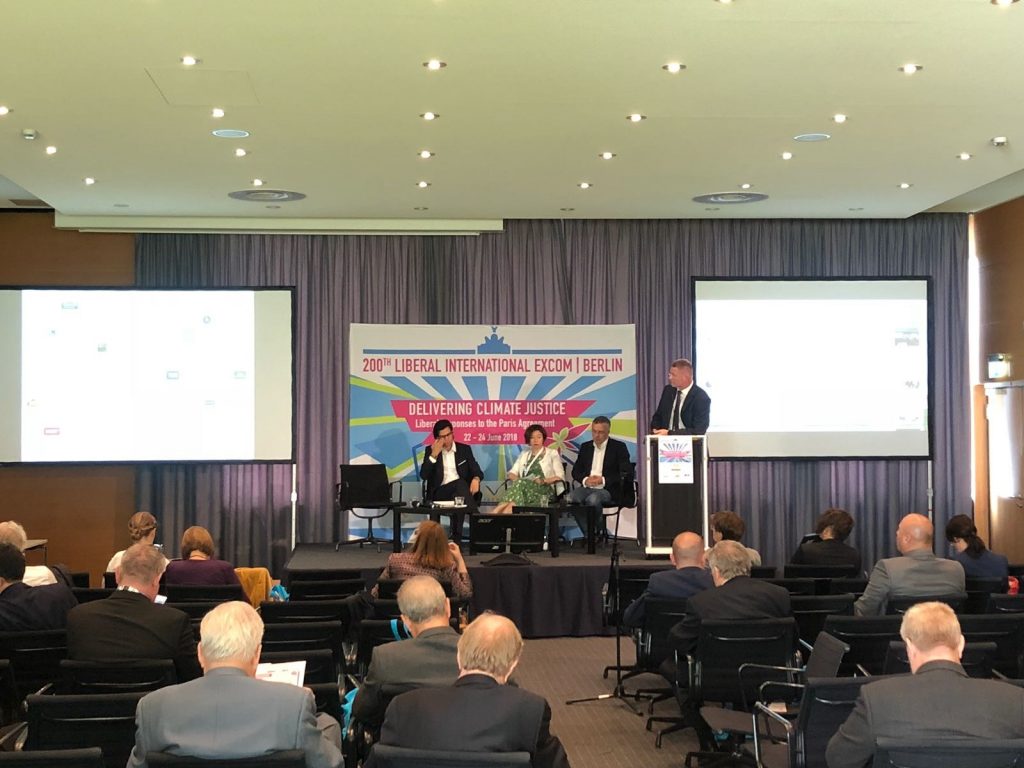
LI HRC Member and Member of the Taiwanese Parliament Dr. Ching-Yi Lin gave a presentation on how human rights are connected to Corporate Social Responsibility (CSR) by providing a Taiwanese specific perspective on the matter. “CSR in Taiwan is a growing concept and businesses are more and more focused on the matter. It is linked to the United Nations’ Sustainable Development Goals and therefore how the SDG’s can be incorporated in companies’ CSR policies has become a key matter. This initiative between SDGs and CSR is a government-led initiative” she said.
Volker Weber, Chairman of the Board of Directors of the Sustainable Investment Forum, stressed that sustainable finance has become a trend as it is very much an issue championed by the European Commission. “As the proportion of institutional investor-ship is growing, there is more reliance on external labels to “prove” that the investment is actually sustainable. While the market of sustainable finance is small at the moment, it is projected to grow by 30-50% in the future” he said.
Deniz Utlu, researcher on business and human rights from the German Institute of Human Rights, focused his presentation on the need for businesses to take more initiative on human rights and stressed that reporting on sustainability matters is not always a mandatory requirement.
The discussions were moderated by LI HRC Chairman and Former German Federal Commissioner for Human Rights Markus Loening.
Leading the Q/A session with the audience, LI HRC Deputy Chairwoman and LI VP Astrid Thors, asked how citizens and consumers can influence the debate on business and human rights. Do we have power in this field if the institutions are taking over to a larger extent as investors? What are the criteria to not invest in a company if they pose an “unacceptable risk” – what is this unacceptable risk?
Liberal International last debated this topic at its 58th Congress in Abidjan, Côte d’Ivoire, 6 years ago.