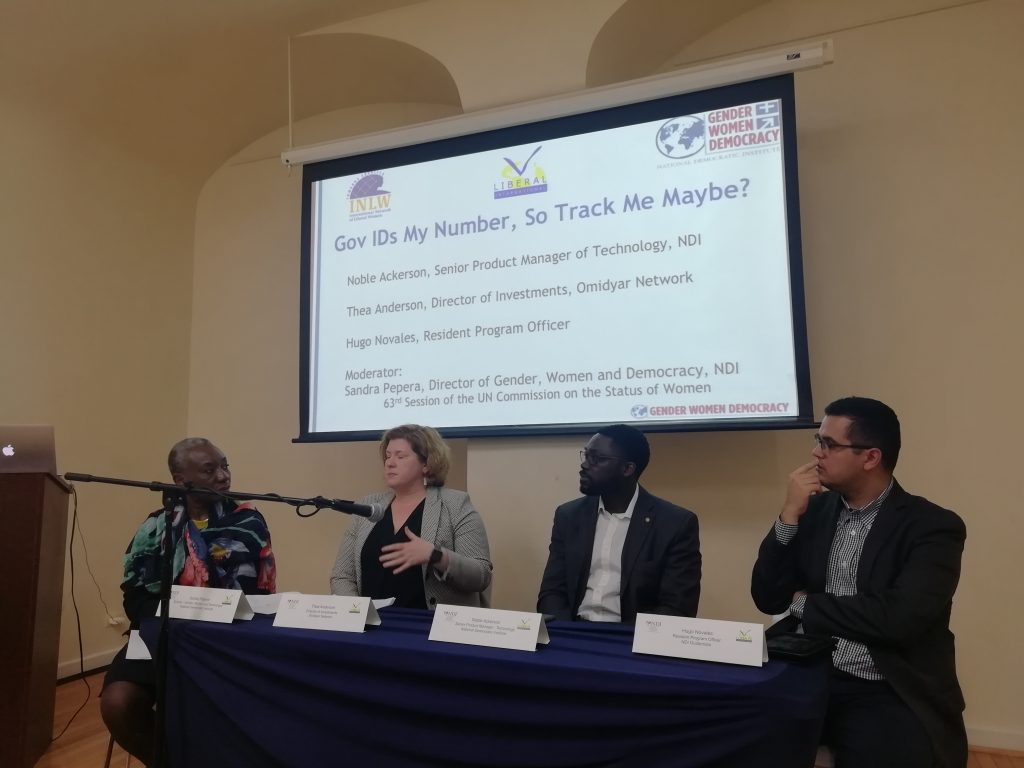
Meeting at the fringes of the 63rd Session of the United Nations Commission on the Status of Women (CSW) for a fifth consecutive year, Liberal International (LI) partnered with the National Democratic Institute (NDI) to examine the implications for social protection and empowerment of digital IDs, and determine the risks that tehnology-based systems present to long-term democratic integrity.
In line with CSW’s priority theme, the speakers of the event – Noble Ackerson (NDI), Thea Anderson (Omidyar Network) and Hugo Novales (NDI) – recognized the improvement that digital IDs have on the efficiency of the interaction between the state and its citizens, while pointing out to the threats that digitalisation poses to individual security.
Emphasizing the necessity for women to be engaged in the policy debate around providing access to digital IDs, Anderson said: “The ability to opt out of the system in national ID systems is important – we need to better understand the implications of digital privacy and human rights. As citizens we need to hold tech companies and governments accountable for the use of our data”.
Ackerson on the other hand pointed to the EU General Data Protection Regulation (GDPR) as a good start by stressing on its far-reaching properties, but cautioned that additional emerging standards are needed in order to make vast amounts of data interact-actable in a safe and private space.
Speaking about the inclusiveness of digital IDs, Anderson said:
“The enrolment … is a critical part when we talk about inclusion. In many countries especially in sub-Saharan Africa and South East Asia – where there is lowest amount of access to IDs – with digital ID systems you are not able to enrol offline. There has to be a certain level of electricity, and that is just not the reality”.
Guided by Sandra Pepera (NDI), participants to the discussions determined that digital ID systems must be built so that they are inclusive and do not undermine citizens’ human rights or their ability to access services, while facilitating participation in open democratic practices without fear of threat or reprisal.
This event forms part of a larger effort to drive debate on the issue among the LI membership by serving to inform LI HRC’s future work in the field.