As part of a Liberal International (LI) campaign to commemorate the 70th anniversary of the Universal Declaration of Human Rights parliamentarians from LI member parties are being invited to write short opinion articles pertaining to some of the UDHR’s primary articles.
A blueprint adopted by world leaders to set humanity on a trajectory towards increased security and greater freedoms; this year we celebrate the 70th anniversary of the Universal Declaration of Human Rights (UDHR).
Rapid decolonisation across continents, development of democratic institutions, and a faster rate of growth and human progress than has ever been recorded followed in the decades after the UDHR’s adoption. So why should the UDHR matter to people in the Philippines, Denmark or any other part of the world today?
We, the authors, are parliamentarians half a world apart – separated by sprawling continents, vast oceans, ethnic nuances, and unique traditions. But we are united by our values: the rule of law, human rights, and individual responsibility among others. The scale of our physical separation or differing cultural backgrounds in no way prevents us from spotting injustice in the world, coming together, and fighting to correct it. Right now, we believe, this fight has not been so important for 70 years.
For one of us, marking a 59th birthday today, defending our shared liberal-democratic values has resulted in 550 days of politically-motivated incarceration.
In 1948, the world’s political leaders possessed an unambiguous motivation, a purpose, and a clear sense of direction – at the heart of which sat democratic ideals like justice. Today, many world leaders are questioning, indeed even turning their backs on, international cooperation simply wishing to avoid the first hint of trouble. No group in our societies – young, old, poor, educated, one race or another – is exempt from the challenges we face in one form or another.
The values enshrined in the UDHR are in desperate need of resuscitation. If freedom-loving, democracy-cherishing peoples fail to come together, to act, to speak out soon, then we will quickly discover that events take over and that we will have started acting too late. Populist-nationalists have our democracies in their sights and they have already fired an opening salvo.
Like the proverbial ‘frog in a pot’ we are sleepwalking backwards towards darker times.
The spectre of creeping authoritarianism draped in a cloak of populist rhetoric has led to the act of defending of human rights itself as being portrayed as the problem, rather than the crucial part of the solution.
Today, it is not enough to oppress and abuse so blatantly. Now, it has to be done in a slow, sneaking manner. First they strip you of your dignity and vilify you; then they falsify charges against you; finally, the point is held in stark relief: the cost of dissent evident for all to see.
We must be concerned with the future as much as we are with the past.
In 2015, as the Philippines’ Secretary of Justice under President Benigno “Noynoy” Aquino III, and Morten as Denmark’s Minister of the Economy and Interior, my country was winning plaudits for its social and economic advancement. Three short years later and most indicators show President Duterte’s Philippines is in serious trouble, the so-called ‘war on drugs’ has seen tens-of-thousands extra-judicially killed, and politicians incarcerated without credible evidence. We cannot sit by while Russian meddling delivers repressive governments in certain European countries; as the politics of division is permitted to pervade the United States; or when human rights that protect workers, voters, and the vulnerable in parts of Asia are throttled to further enrich the powerful.
Inaction is a choice, not a defence: one of the fathers of British liberalism, John Stuart Mill, summarised this forcefully when he wrote “let not any one pacify his conscience by the delusion that he can do no harm if he takes no part, and forms no opinion. Bad men need nothing more… than that good men should look on and do nothing.”
At its core the UDHR is a device, a functional mechanism, to bring world leaders together and agree on a basic set of principles relating to the treatment of people. If a president here or a prime minister there begins to stray from these commitments then it is our joint responsibility – from senior politicians to grass-roots campaigners – to stand up, to object, and to work together to ensure that everyone honours his or her commitments.

Morten Østergaard MP, Folketing,
Denmark (Political leader of Radikale Venstre)
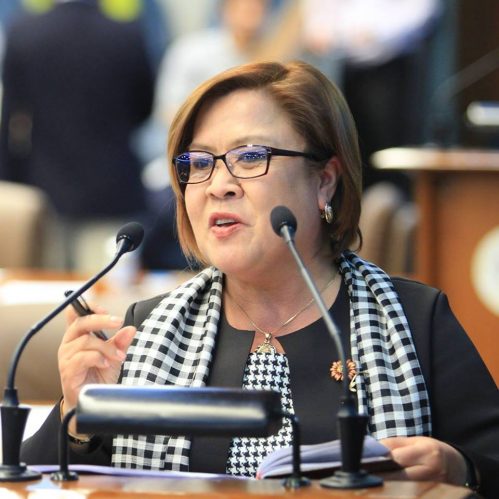
Senator Leila M. de Lima, Camp Crame,
The Philippines (Secretary of Justice – 2010-15)