

Under the theme Imprisoned for Thinking, the Liberal International Human Rights Committee met at the headquarters of the United Nations Human Rights Council (UNHRC) in Geneva for a fourth consecutive year, focusing its debates on the principle of freedom of expression.
The meeting, co-hosted by the International Federation of Liberal Youth and the Swedish International Liberal Centre (SILC – LI cooperating organisation) with the support of the ALDE Party (LI cooperating Organisation), aimed at offering a powerful fight back for freedom in light of the decline of civil and political rights in many parts of the world, including an increased number of journalists behind bars, more prisoners of conscience and liberal politicians being harassed and threatened in their daily work.
In their welcoming remarks LI President Dr. Juli Minoves cautioned that “the norm of liberal democracy is eroding in international affairs”, while Caroline Green (IFLRY) emphasized that “enabling the youth voice at the UNHRC is crucial for the sustainability of a liberal future.”
The first panel debated the criminalisation of political activity and featured the Director of the Boris Nemtsov Foundation Olga Tikhomirova alongside LI HRC Member and Africa Liberal Network (ALN) Vice-President Medard Mulangala.
In her presentation, Tikhomirova launched a call towards the international community to be firm with President Putin and condone the ongoing crackdown on dissent by the Russian regime as an unacceptable practice. Mulangala, on the other hand, stressed that while the volatile political situation in the Democratic Republic of the Congo and the Republic of Congo has received some support from the international community, there is an urgent need for a national dialogue. “Liberal International should continue to raise awareness to make our case better known in the international arena” he concluded.
Chair of LI Human Rights Committee and LI Vice-President on the Bureau, Markus Löning, emphasised the need to provide support for political movements that want to improve democratic transition as “there is an obligation for those who have privilege to support those who don’t when it comes to human rights.”
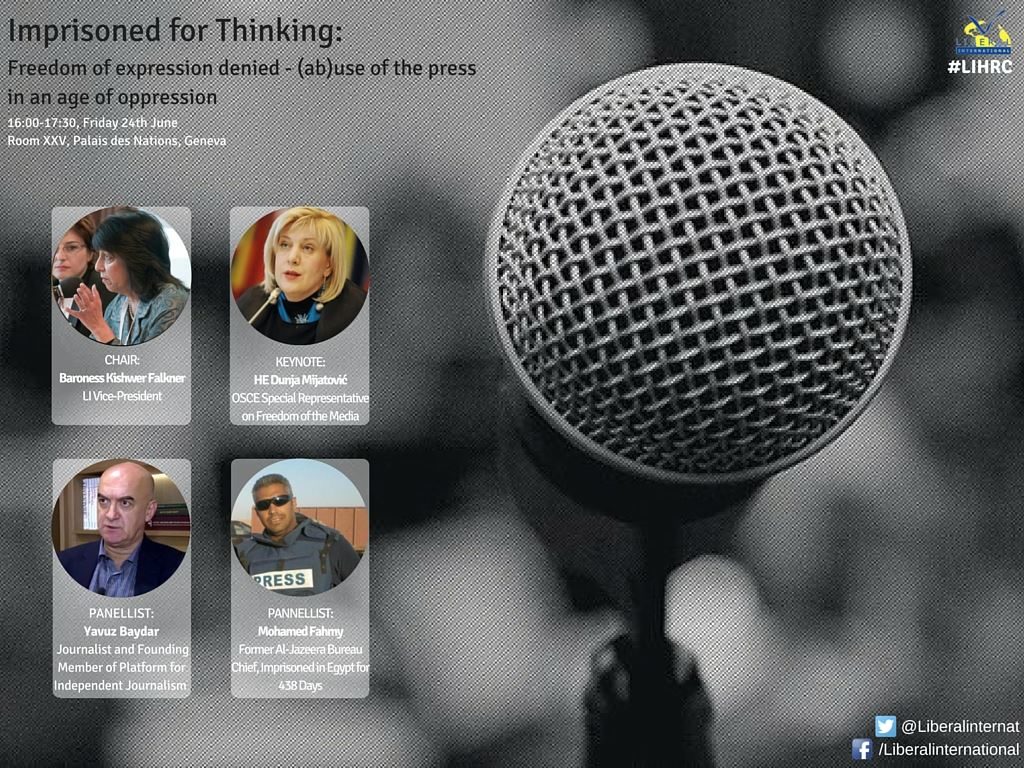
The second panel saw lively debates around the (ab)use of the media by illiberal governments. OSCE – The Organization for Security and Co-operation in Europe (OSCE) Special Representative for.
Ten months after his release from a 438 day prison sentence for doing his job, international journalist Mohamed Fahmy used his participation at the LI Human Rights Committee meeting to call for the establishment of a United Nations Special Rapporteur for Journalists’ Safety.
The panel also discussed the politicised oppression of the media in Turkey, where opposition journalist and founding member of the Platform for Independent Journalism (P24) Yavuz Baydar, shared his personal experience with regards to the harsh crackdown on freedom of expression by the government of President Erdogan.
LI VP on the Bureau and Member of the House of Lords, Baroness Kishwer Falkner (Liberal Democrats, UK), moderated the session reminding those present that “if we are silent when the press wants to tell us something then we might as well be all silent.”
The discussions were furthered during the working lunch session which was opened by LI HRC Member and SILC Information Officer Åsa Nilsson-Söderström and saw a bilateral briefing by Spela Kosic, a Human Rights Expert with the Sloveninan Permanent Representation to the United Nations. Kosic gave an overview of the working mechanisms of the Human Rights Council and the work of the Slovenian Representation to the United Nations on the issue of political prisoners.