To the editor:
From Anson Chan and Martin Lee
We write from Hong Kong to debunk the unfortunate “expert analysis” by Dr. Tim Summers published by Chatham House purporting to address the role and responsibility of the United Kingdom in the territory’s recent protests.
Hong Kong people know our fight is in Hong Kong, but it is our right and responsibility to protest at the breaking of the Joint Declaration and the Basic Law’s important promises that Hong Kong people could rule Hong Kong with the promised “high degree of autonomy.” And we expect Britain, as the co-signer of the historic international treaty, to speak up when a treaty it is party to is being broken in letter and in spirit.
Dr. Summers, Senior Consulting Fellow in the Asia Programme of the Chatham House, whose bio explains that he “consults commercially on China,” argues in a nutshell that the UK should wash its hands of the responsibility as a co-signer of the international treaty, the Joint Declaration, claiming “the idea… that the UK is somehow still responsible for their well-being sounds outdated.”
The whole point of international treaties registered at the United Nations is that they do not go out of date.
Hong Kong people are determined to fight for genuine elections because it is the only way to protect our core values and rule of law under Chinese rule. In the decades before and the seventeen years since Hong Kong’s handover from Britain to China in 1997, Hong Kong people have fought to preserve our unique freedoms and stave off China’s corruption and political demands, while waiting for the promise that we would have “universal suffrage” to elect our chief executive in 2017, and all our legislators in 2020.
The current crisis in Hong Kong has deep roots that date to the UK’s denial of democracy at China’s behest before the handover. Beijing’s attempts to control judges, journalists, and who we can vote for is a clear violation of the “one country, two systems” we were promised in the Joint Declaration.
Indeed, generations of British leaders trumpeted their pledge to defend rights and freedoms in Hong Kong: In 1996, Prime Minister John Major declared, “If in the future there were any suggestion of a breach of the Joint Declaration, we would mobilize the international community and pursue every legal or other avenue open to us.” As last governor Chris Patten wrote in the Financial Times recently, “Britain is honour bound to speak up for Hong Kong.”
In mainland China, screening out critics is the norm. But in Hong Kong this undermines transparency, legitimacy, and the integrity of our system of government from the top down. By denying Hong Kong people the right to select whomever we want as candidates for office, together with attacks on critics and journalists, Beijing’s interference is undermining the fragile framework that protects basic rights in Hong Kong.
Worse, it has set up perpetual confrontation with Beijing and leaves Hong Kong people with democratic aspirations no outlet other than taking to the streets.
A solution to the current crisis exists: China needs to honour the treaty promises of “Hong Kong people ruling Hong Kong with a high degree of autonomy.” Britain has an obligation—including a legal obligation—to insist that China’s current leaders live up to the commitments made by their predecessors.
The Hon. Anson Chan GCMG GBM CBE JP
and Mr Martin CM Lee QC SC JP
Anson Chan was the first woman and the first Chinese to become head of the Hong Kong civil service, a post she held from 1993 to 2001, thus transiting the change from British to Chinese sovereignty. She is currently convenor of Hong Kong 2020, a think tank founded in April 2013 to lobby for the achievement of full and genuine universal suffrage no later than 2020.
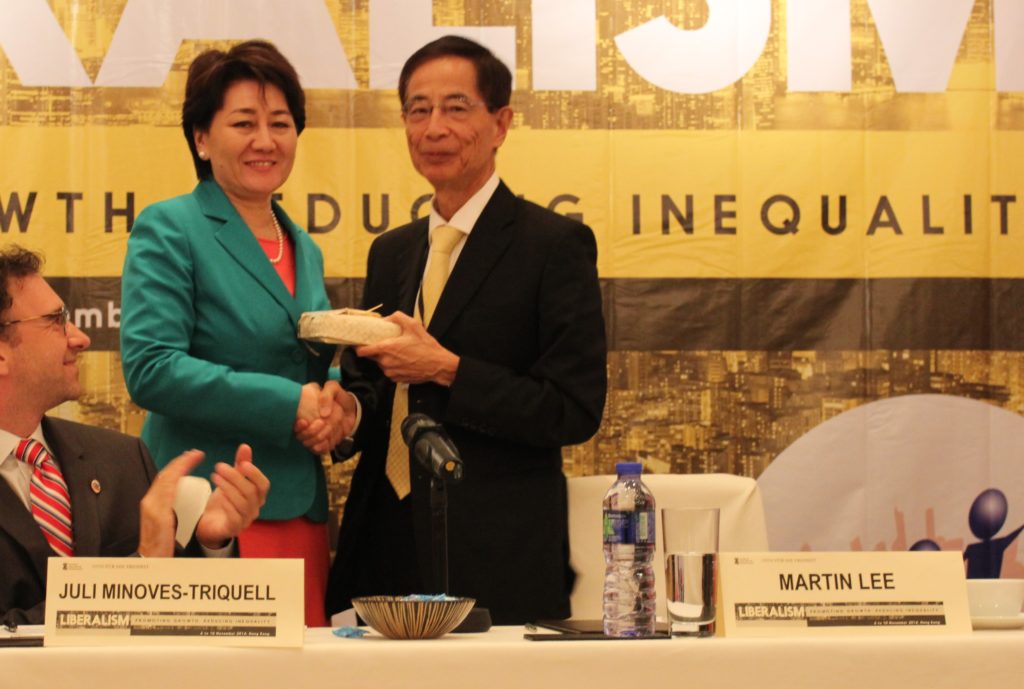
Martin Lee QC has been one of Hong Kong’s most respected legal practitioners for over four decades. He is the founding Chairman of the Democratic Party of Hong Kong. Originally elected to represent the legal profession, he stood for election in the Hong Kong Island geographical constituency five times and was re-elected with substantial majorities until his retirement from the Council in 2008.