
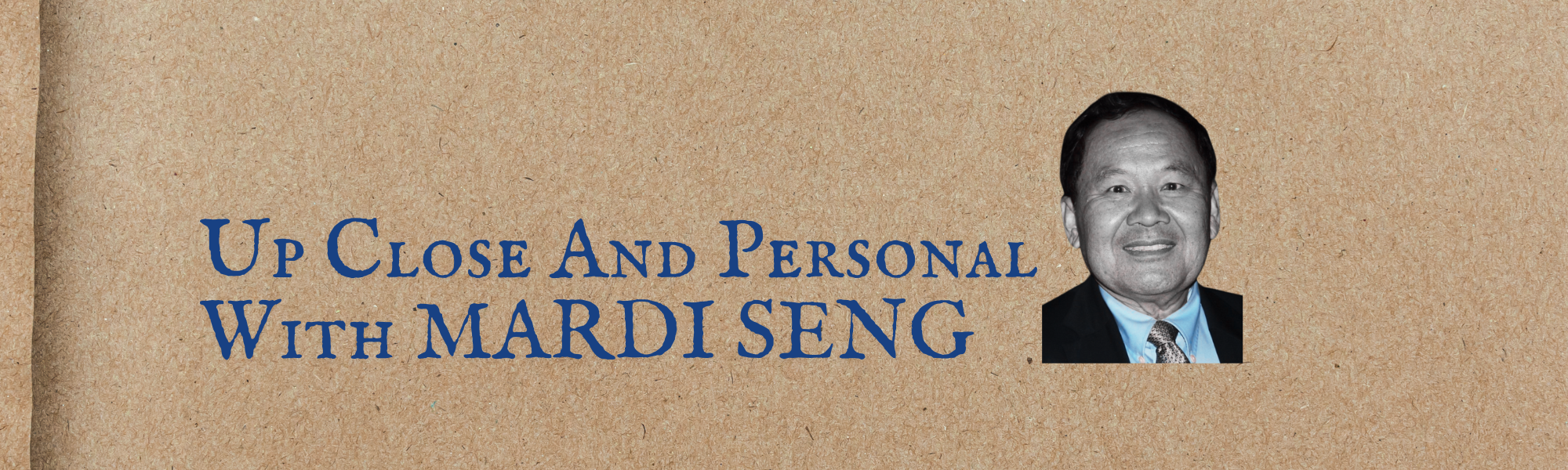
Mardi Seng, CALD Chairperson in Conversation for LI’s Reimagined Newsletter – The Liberal Dispatch
The scars of the Khmer Rouge genocide run deep for Mardi Seng. Yet, from the depths of personal tragedy, he has risen to become a formidable advocate for liberal values. Guided by the unwavering belief that freedom and human dignity are fundamental rights, he fights tirelessly against oppression and injustice in his native Cambodia and the region. His story is a testament to the transformative power of the human spirit and the enduring fight for a world where no one must endure the horrors he witnessed.
Why are you passionate about advancing liberal values and what does it mean to be a liberal to you?
At a very young age, I and my four siblings lived through and survived the Khmer Rouge genocide where individual rights, liberty, political equality, private property, and equality before the law were non-existent. Both my parents, along with two million Cambodians, were killed senselessly. Our very lives could have been ended arbitrarily at someone’s whim at any moment. This permanently scarred my childhood.
After migrating to and taking refuge in the US as young children, my siblings and I were schooled in Christian schools in Michigan, where we learned about humanity, human dignity, equality, liberty, and more importantly LOVE. We did not just learn about them; we practiced them; we breathed them; we lived them through the support, kindness, and love of the Christian community. Learning, practicing, breathing, and living humanity, kindness, and love partially healed the childhood scars and turned them into a life-long calling to advance humanity and hope.
For me then, liberalism is just another word for being human – for being free while remaining compassionate with the plight of others. The desire to be free, and to prevent the suffering of others, is something innate in our humanity. So, advocating for liberal values, for me, is like fighting for our humanity – for what truly makes us humans.
I believe that all human beings are born with reason. Having such faculty means that we know what is best for us, and that we are the best guardians of our interests. At its most basic, we know the acts that will harm us, as well as those that will harm others. This awareness leads us to believe that everyone has inherent rights by virtue of their humanity. Since we are rational beings, we should have the rights – and the freedom – to decide which course of action would best serve our interests. We should also have those rights because we inherently know that these rights cannot (or should not) impinge on the rights of others. And given that human beings are endowed with reason and rights, any exercise of power over us can only be done through representative government. This means that the government derives its authority from our consent. Once that consent is withdrawn, government authority revolves back to us – who, in turn, can place it in another government that will get our trust.
So, in summary, being a liberal for me is about the essence of our humanity – which is to be free and to prevent the suffering of others. Our freedom derives from our possession of reason – which is the most distinguishing characteristic which separates us from animals. And because we have reason, we can respect the rights of others and exercise our rights responsibly in choosing the government that would represent us.
I am passionate about advancing liberal values because I believe that these are the values that define our humanity. Democracy, human rights, and the rule of law, among other liberal values, are in consonance with our nature as human beings. Without this, we will be no different from animals.
How would you describe your own transformation through these 40 years of political experiments in Cambodia? From escaping the torturous Khmer Rouge regime to campaigning in support of political prisoners?
During my high school, college, and professional years in the US, I was invited several times to share my surviving-a-genocide experience as a story of hope at churches, high schools, colleges, universities, and social clubs throughout Michigan and Northeastern states of the US. I narrated my story many times, no matter how harrowing it was, because I believe that this could be my share in preventing future genocides in the world.
I remembered in September 1994, sitting in a room in Auschwitz concentration camp watching a film; and at the end of the film, the narrative said “…never again.” I was sobbing so loudly after hearing those two words — “never again.” In my mind, if the world really committed to preventing genocide, then my parents would still be alive. Those words — “never again” — ring in my heart until this very day, and they are a constant reminder that the struggle to fight and defend liberty and humanity is ongoing.
Throughout the struggle, I have learned to endure, persevere, and be resilient, but this also requires tenacity, optimism, hope, and love. Going up against the evils of autocrats and dictators — without tenacity, optimism, hope, and love — would be like a brush fire.
Hence, the events of the past 40 years or so not only made me strong and resilient but also, ironically, hopeful, and optimistic. If you were a Cambodian like me, it may be hard to be an optimist and hopeful, especially given what happened before and what is still happening today, but I remain to be a firm believer that (positive) change will come.
During the rule of the Khmer Rouge, almost every Cambodian family lost a loved one when the genocidal regime killed about a third of the country’s population in the 1970s. As mentioned, me and my siblings had to emigrate to the United States for our safety after our parents were killed.
Cambodia at present also has the dubious distinction of having the longest-reigning dictator in the world, who recently handed over the reins of power to his son as if it is a family heirloom.
In my country, activists and members of the political opposition are also routinely harassed, threatened, and killed. The political party where I belonged, for example, was prevented from participating in the last July 2023 elections on a minor technicality.
My sister, an accomplished lawyer in the United States, is languishing in jail for more than a year now for allegedly conspiring to commit treason.
For those of us who are living in Cambodia, we fear for our lives and freedom every single day.
But these did not deter me from remaining hopeful and optimistic. This is because I always believe that no matter how bad the situation is, it will change, and life will get better.
My sense of optimism, however, is not the false type — but an optimism backed by competence and hard work. Yes, things will always get better. But they will not happen out of thin air. We have to work – and we have to work hard – to make them happen.
That is why to this day, I still tirelessly work, above ground and behind the scenes, to free my sister and other political prisoners. I have to admit, there were days when I felt that we were not making any dent, but I just kept on pushing. I tell myself – someone has to do the job now if we are to reap the rewards in the future.
Is there a specific moment, experience, or individual that inspired you to become a human rights activist?
I think the Khmer Rouge regime made a lasting impact on me as it was very personal. As I said, I lost my parents to the regime, and me and my siblings had to emigrate to an unknown land because our lives were in danger.
Even at a young age, I was thinking at that time how some people can be so cruel towards others – particularly the innocent and vulnerable ones. It made me realize, as they say, that “power can corrupt, and absolute power can corrupt absolutely.” The desire for power can bring out the worst in human beings and eclipse our inherent good nature. From that time on, I told myself that I would dedicate my life to protecting the innocent and the vulnerable from those who think that being in power gives them the license to do everything they want.
It is also for this reason that I have always advocated for a strong political opposition in Cambodia. The checks and balances provided by the political opposition, whether inside or outside of government, can counter the worst tendencies of the ruling party. Because the political opposition in Cambodia was prevented from fulfilling this role, my country is what it is today.
Given the current political situation in Cambodia, the work is cut out for human rights activists working inside the country and outside. The work for democracy, human rights, and the rule of law never stops, and it can drain even the most committed of activists. But I always tell them – if you are tired, rest so that you will regain your strength and go back to continue the fight. Rest – yes, but do not stop. Because ultimately, our efforts will be rewarded.
How do you view the role of digital media as a tool for resisting injustice or oppression among young Cambodians?
The digital media, and the Internet in general, has played a very critical role in keeping the fight for democracy in Cambodia alive. Because of events in the past decades, and the worsening political situation at present, a lot of Cambodians have sought refuge abroad in what is known as the Cambodian diaspora. These Cambodian communities abroad remain to be active in working for democracy in the country through the digital media. The digital media has not only become a repository of information and a networking tool but has also been a mechanism for transnational resistance.
Digital media’s role in resisting oppression is also important given the current state of the mainstream media in Cambodia. Considering that media outlets that were relatively independent or neutral were either closed down or continuously harassed, it has become more and more difficult for people within Cambodia to get credible news. The digital media, therefore, became an alternative source of information in a country that was predominantly bombarded by government propaganda. It is for this reason that
attempts to control the internet, such as the Cambodia internet gateway, should be resisted as this will stamp out the last vestiges of reliable information in the country.
Your resilience is inspiring not just for Cambodians but for people all around the world fighting autocratic leaders and regimes. What’s your message to fellow dissenters?
If I would only have one message to fellow activists and dissenters, it would be to never, ever give up.
I am aware that this is easier said than done, especially when you are in a seemingly hopeless situation, or when, like me, you are not getting any younger. The temptation to just give up and live a peaceful life away from politics will always be there. I would be a hypocrite if I said that I did not think of it myself.
But if there is one thing I realize from my decades-long struggle for a more democratic and equitable Cambodia, it is that you can never really be at peace with yourself when you know that your countrymen are suffering and that you have not done everything you could to alleviate that suffering.
It is for this reason that members of the Cambodian diaspora continue to be active in the democratic movement. Many of them have already established careers and living comfortable lives in their host countries – the United States, France, and Australia, among others – but they continue to fight for democracy, human rights, and the rule of law in their native Cambodia.
I also draw inspiration from them when time gets tough. Actually, we draw inspiration from each other. And I think fellow activists and dissenters should do that do. Democracy work can be tiring — draining even – so it always feels good to know that we are not alone in the fight.